
Urban Design: Using Data in Urban Planning

Technological advancements change the way we learn, the way we communicate, and the way we live. With an increasing amount of data available about our built environment and those who live in it, urban planners are discovering new ways to incorporate data into city planning and design. This week, our Project Manager Josh shared his thoughts on a recent lecture regarding the use of data collection for the advancement of city planning, and reflected on the potentials of data collection for architecture.

Written by Josh Janet, Project Manager | PE:

 I had the good fortune to be able to take an Urban Form course with Professor Anne Moudon at the University of Washington two years ago. After 34 years with UW, Anne decided to retire, allowing more time for herself to travel the world and to focus more research in the Urban Form lab that she helped establish with the Department of Urban Design and Planning.

The Department held a celebratory final lecture and cocktails event this past Saturday in her honor. Current professors, former colleagues, and past students listened as Anne gave a brief whirlwind history of a subject near and dear to her — the collection and application of data on urban life to influence how we can improve our cities and ourselves.
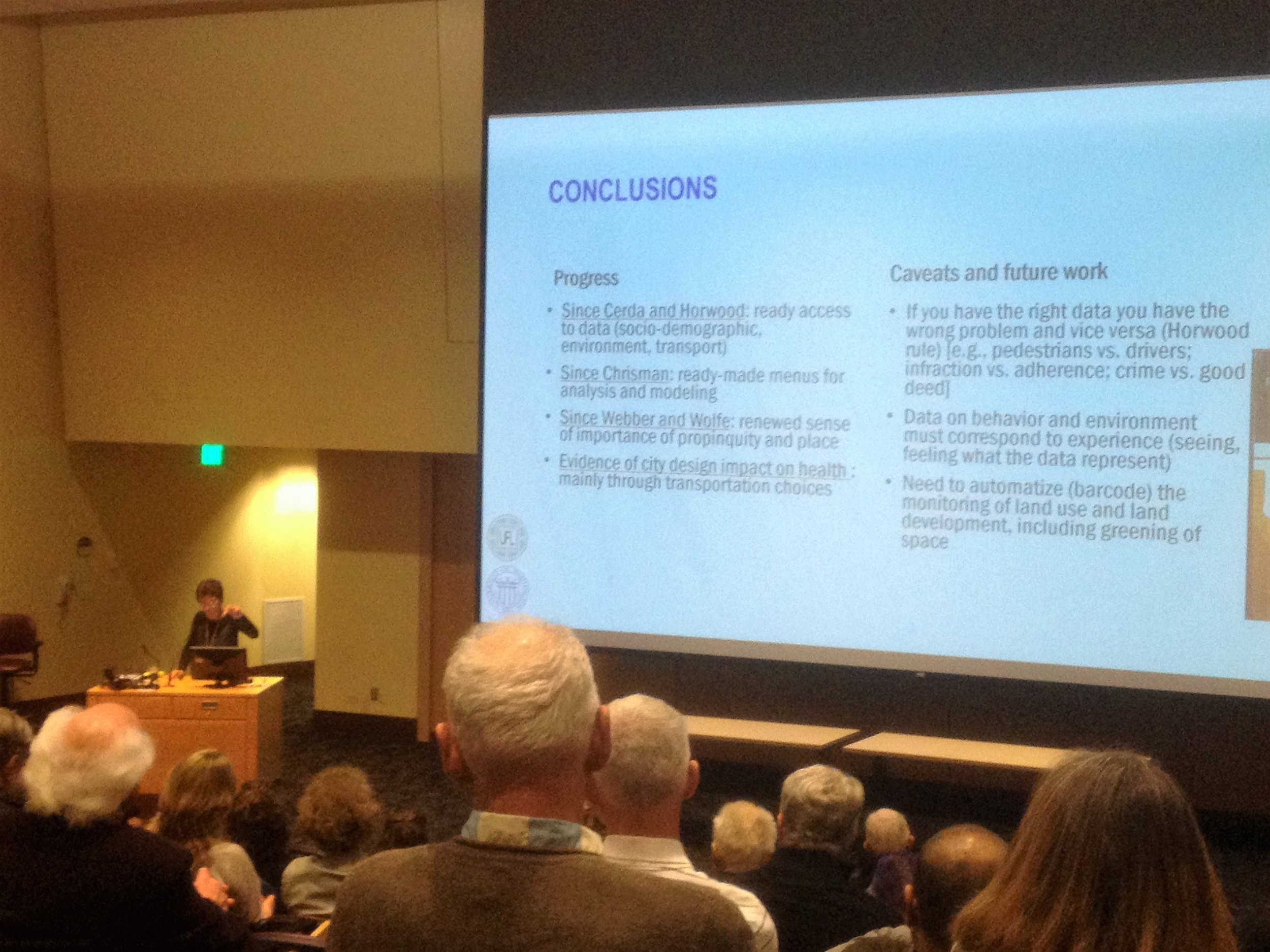
Professor Moudon delivering her closing remarks   |    photo by Josh Janet

Professor Moudon delivering her closing remarks   |    photo by Josh Janet

She first spoke of Ildefons Cerdà, the world’s first urban planner, who expanded Barcelona in the 1850’s with the Eixample district to address mass health issues due to overcrowding. Cerdà relied on data collected on myriad subjects — from the sizes and lengths of streets to the volume of air one person needed to breathe — to inform the development of the new district. The Eixample isn’t all that well regarded by architects with regards to urban form — there are little to no landmarks in the district and the grid layout is monotonous as a result — but Cerdà’s 1867 publication, “General Theory of Urbanization,” was the first of its kind in developing the new field of urban planning.

Aerial image of Eixample   |   Images via Amusing Planet

Aerial image of Eixample   |   Images via Amusing Planet

Anne continued with the innovations of Sir Patrick Geddes, the Scottish planner who developed ideas related to regional urban planning and “conurbation,” or the continued urbanization of areas beyond central cities, in the early 19th century. He developed the “Valley section model” as a representation for how regional environmental characteristics shaped city institutions and values.

The “valley section model” created by Patrick Geddes   |   Images via Wikimedia commons

The “valley section model” created by Patrick Geddes   |   Images via Wikimedia commons

Anne finished with the Puget Sound region and the advancement of geographic information systems (GIS), beginning with the founding of the Urban and Regional Information Systems Association (URISA) by former UW professor Edgar Horwood in 1963. Horwood, a civil engineering professor, was fundamental in the guiding of information system development for urban and regional applications. We would not have complex mapping software like ArcGIS today if not for Horwood’s foresight and leadership.

The use of data collection for the advancement of city planning is an obvious fit, but it got me thinking about the lack of data collection for architecture. Our work is so site and client specific that it is difficult to apply broad ranges of data sets to our designs and applications. We innovate where possible, of course — we listen to clients’ needs and may research what new technology or materials may exist that can address lighting, energy, or durability concerns (assuming it falls within a normal budget).

At Urbal, we also regularly update our senior housing programming based on the information that we receive from clients, who make their suggestions based on the data they collect from their residents and staff. These can range in scale from the size of certain spaces, like a Wellness Center, to the location of the control valves in roll-in showers.

Architects have to strike a precarious balance between pioneering new and/or untested building systems, materials, and programming arrangements, and chasing the zeitgeist with outdated technology and modes of thinking. We also face the prospect of being replaced by computers, if companies like Flux (an offshoot of Google X) are able to truly integrate the complex web of zoning codes, building codes, accessibility codes, structural codes, fire codes, and mechanical/electrical/plumbing codes into a single development tool. I remain skeptical (if perhaps just a little biased) that any computer system can replace the need for a design team, but in honor of Anne Moudon’s insistence on the need to automatize land use development for urban development, I’ll try to keep an open mind. 


Sources:

  • Bausells, Marta. “Story of Cities #13: Barcelona’s unloved planner invents science of ‘urbanisation.’ ” The Guardian. 1 April 2016. Available WWW: https://www.theguardian.com/cities/2016/apr/01/story-cities-13-eixample-barcelona-ildefons-cerda-planner-urbanisation.
  • Marshall, Victoria. “The Valley Section.” City in Environment. 16 February 2013. Available WWW: http://cityinenvironment.blogspot.com/2013/02/the-valley-section.html
  • Dueker, Kenneth J. “Edgar Horwood.” URISA. Available WWW: http://www.urisa.org/awards/edgar-horwood/.

Urban Design: Adapting Parking Structures for Homes

In our previous blog post on the adaptive reuse project of King Street Station, we chatted with our Project Manager, Josh, to learn about the unique opportunity of creating an urban cultural space in Seattle’s historical train station. This week, continuing on the theme of adaptive reuse architecture, Josh revealed the potentials of adapting parking structures for residence use, and discussed another unique project in downtown Seattle — the Tower at 4th and Columbia project, which might include four floors of above-grade parking that can convert into living spaces.

Written by Josh Janet, Project Manager | PE:

Before I joined Urbal Architecture, I worked for six years at an A/E firm that designed parking structures. With sustainability and adaptive reuse as recurring themes in architectural design and urban planning over the last two decades, I have often been asked about the possibility of renovating and adapting existing parking structures for use as new residences, similar to how vacant warehouses in de-industrialized cities have been transformed into high-demand lofts.

Sadly, the reality is that there are too many obstacles in how parking garages are (and have been) designed that if the land beneath is desired for higher-density uses, then the most cost-effective and practical solution is to demolish the structure and start anew. In a recent Wired article, however, it seems that LMN Architects is designing a new above-grade parking garage in downtown Seattle with many of these challenges addressed up front.

Proposed rendering of the 4th and Columbia project.   |   Image by LMN Architects via Wired

Proposed rendering of the 4th and Columbia project.   |   Image by LMN Architects via Wired

1.       Design load: Building codes require structural engineers to only design parking structures for 40 pounds per square foot (psf) live load, while apartment loading varies from 40 psf in interiors to 100 psf in corridors. Accounting for the possibility of higher loads in design, while adding construction cost, mitigates the need for extensive structural rehabilitation if and when the building use changes.

2.       High ceilings: Parking garages are only required to provide a 7’-0” clearance for standard vehicles and 8’-2” for floors accommodating ADA vans. Most designers try to minimize material and labor cost by keeping the heights as low as possible. Accounting for higher ceilings up front allows future residential uses to not feel claustrophobic as well as account for the physical space required for future mechanical heating, ventilation, and air conditioning equipment.

3.       Ventilation: Above-grade parking garages can avoid substantial construction and operation costs if they are designed with sufficient “openness” in the exterior facades that the building is considered to be naturally ventilated. This “openness” becomes an issue for adaptive reuse, however. All of those openings would need to be enclosed and properly sealed for waterproofing and thermal protection if it was expected that the spaces would be permanently occupied.

4.       Ramped floors: This is the one area of LMN’s project that I’m still skeptical has been completely addressed. Floors in parking structures are ramped for two reasons- to move vehicles between floors and to direct any surface water to drains (standing water is both a slip hazard and structural maintenance issue). An enclosed structure reduces the amount of rainwater that would enter the structure, but cars can still carry/drip water with them that needs to be drained somewhere. The amount of water expected here may be so minimal that there is less concern of creating unsuitable conditions, but I’ve seen a parking structure built with completely flat slabs before (underneath a hospital) where the engineer informed the owner that their solution to the standing water problem was to “hire someone who can push the water into a nearby drain with a broom.”
Additionally, vehicular elevators are a creative solution, but they can create queuing issues at high volume periods; off-line maintenance periods make that parking garage unusable during that time; and unless we’re talking about driverless cars or the functionality is dummy-proof, there could be human error involved in how the vehicular elevator is used.

Regardless of that last concern, it is highly commendable to LMN Architects for approaching the challenges of adaptively reusing parking structures up front and to the developer for accepting the associated construction and operational cost premiums. Cities are constantly reinventing themselves over time, and the ability to adapt the physical environment to meet new challenges is a greener solution than demolition and starting over.

Glass Cottage: Construction Is In Full Swing!

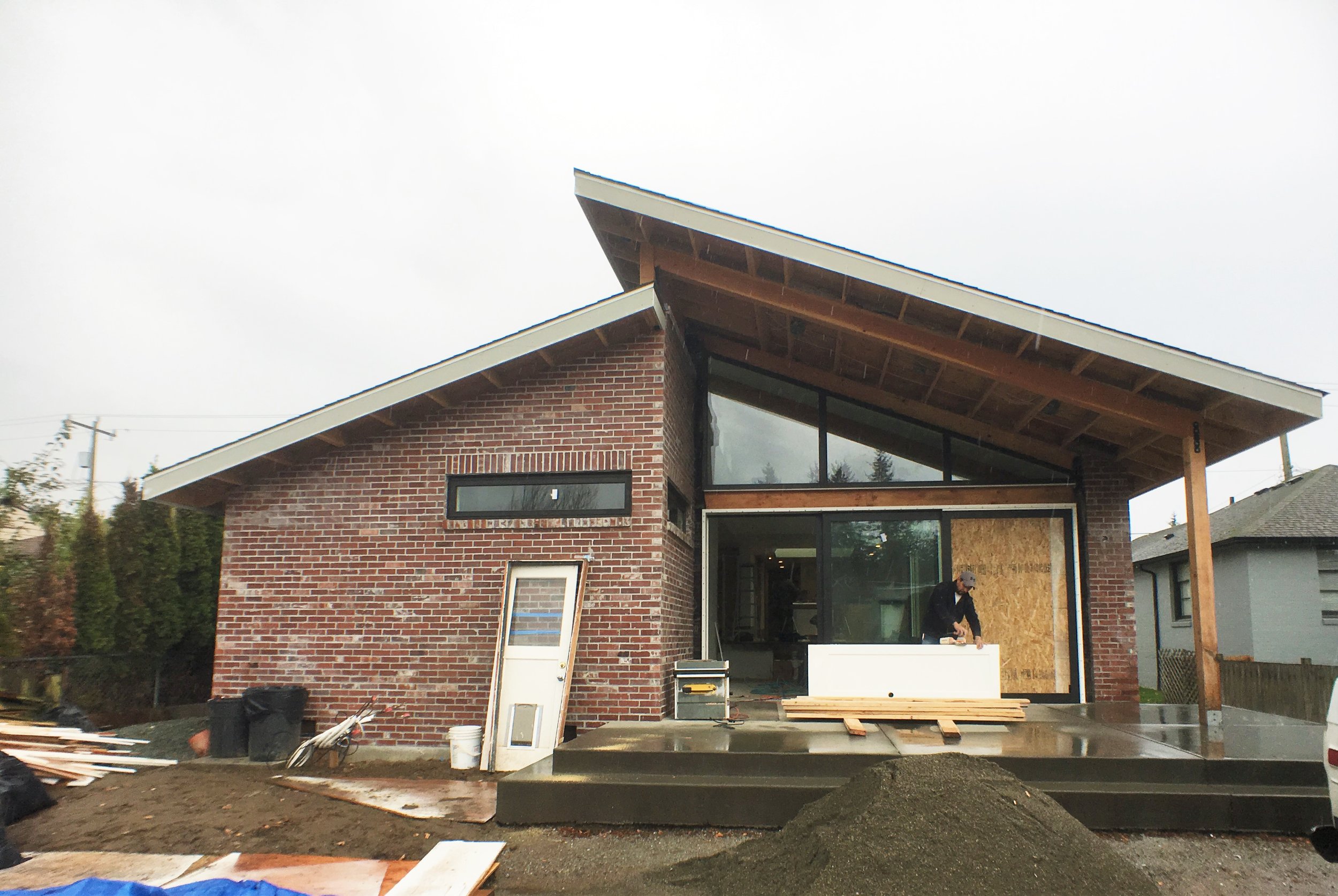
Glass Cottage, situated in the Magnolia neighborhood of Seattle, is gradually growing into a modern, alluring home. In the past few months, framing and drywall installation were completed, and windows and new roof were installed. The project is now in full-swing construction mode, with finishes and details left to implement. We're so excited to see how this house is shaping up to be a beautiful, contemporary home with better functionality and open sight lines.

The back of the house is looking closer and closer to the proposed rendering! 

The addition features contemporary exterior with brick siding, an overhang shed roof and an at-grade covered patio space.

Floor-to-ceiling glass glazing along west facade floods the interior space with natural light throughout the day. 

Shed roof above the new living room adds volume and space, while skylights and sliding glass doors in the kitchen and dining area let in extra natural light.

2016-11-09 Maduzia Site Visit (4)_edit.jpg

The current unfinished basement will be finished out to include a guest bedroom, a new laundry and powder room adjacent to the garage, and a large play area and family room.  

Much more to come on the progress with this home, stay tuned!